

Five stories this week, from a global Microsoft outage and a new AI safety regulator in Canberra to Black Friday scams, NSW classroom devices and Instagram's age checks for teens.
The thread running through them is who checks the technology families rely on every day. Most of it needs nothing from you, and the few things that do are quick.
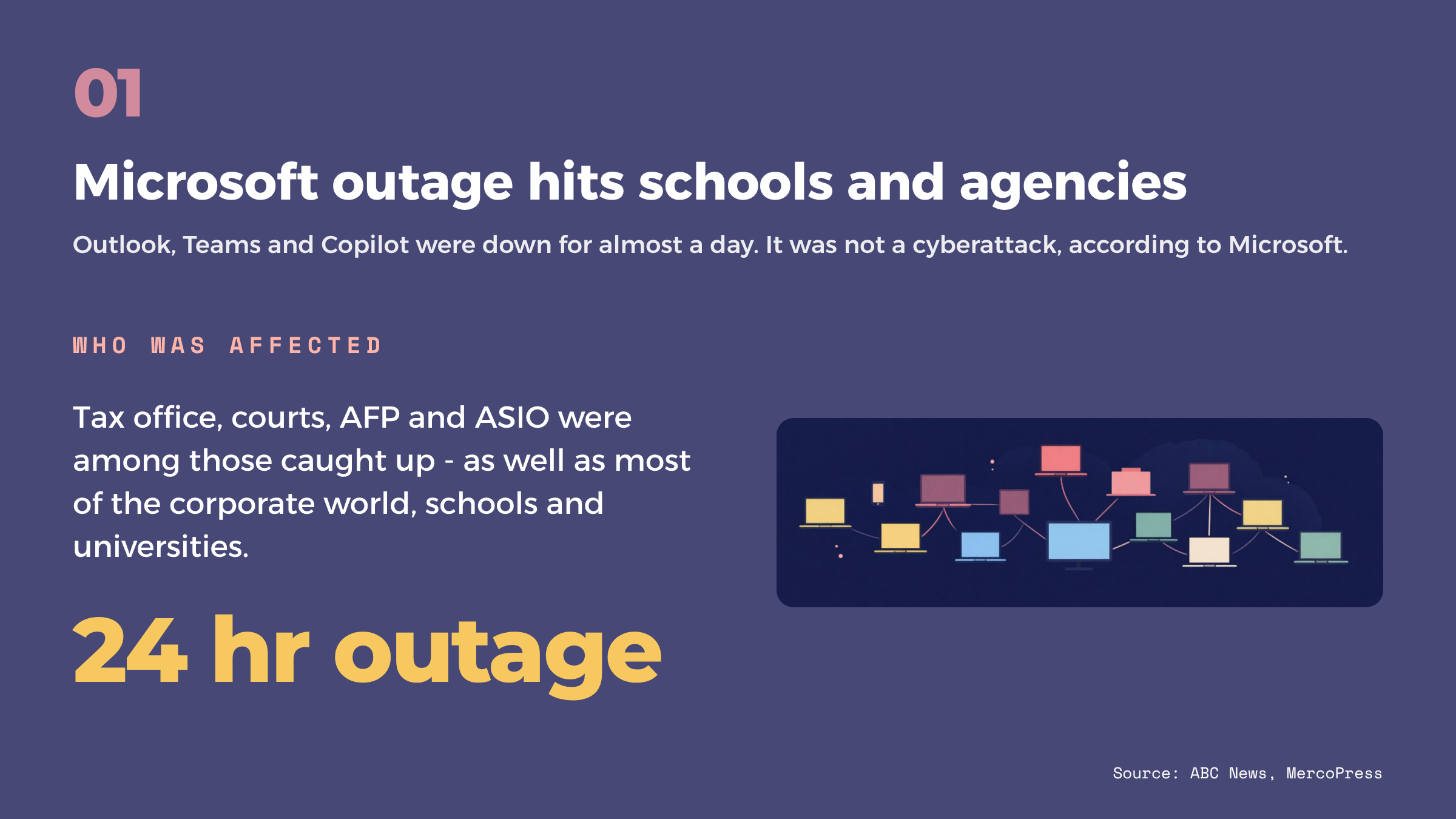
01. Microsoft outage hits schools and agencies
Outlook, Teams and Copilot went down around the world on Friday morning, Australian time, just as the working day began. Schools, courts, councils and government agencies warned they could not be reached by email. The Australian Federal Police and ASIO both confirmed they were affected.
Some schools texted parents to phone in absences, and some could not run online classes. Services started to recover after roughly 18 hours, with delayed emails still arriving after that.
Microsoft apologised and said it was a technical issue, not a cyberattack and not related to AI agents. Home Affairs Minister Tony Burke said the government had activated an agreement that requires Microsoft to prioritise Australia's recovery.
What it means for you: If you emailed your child's school on Friday, check it arrived. That goes for absence notes, permission forms and anything with a deadline. Be wary of messages asking you to "restore" or "verify" a Microsoft account. The Victorian Government warned that scammers were using the confusion.
What's next: Microsoft says it has fixed the underlying problem and is clearing the email backlog. Expect more questions about how much Australian schools and agencies depend on one provider.
Read more:
02. Australia to create an AI safety regulator
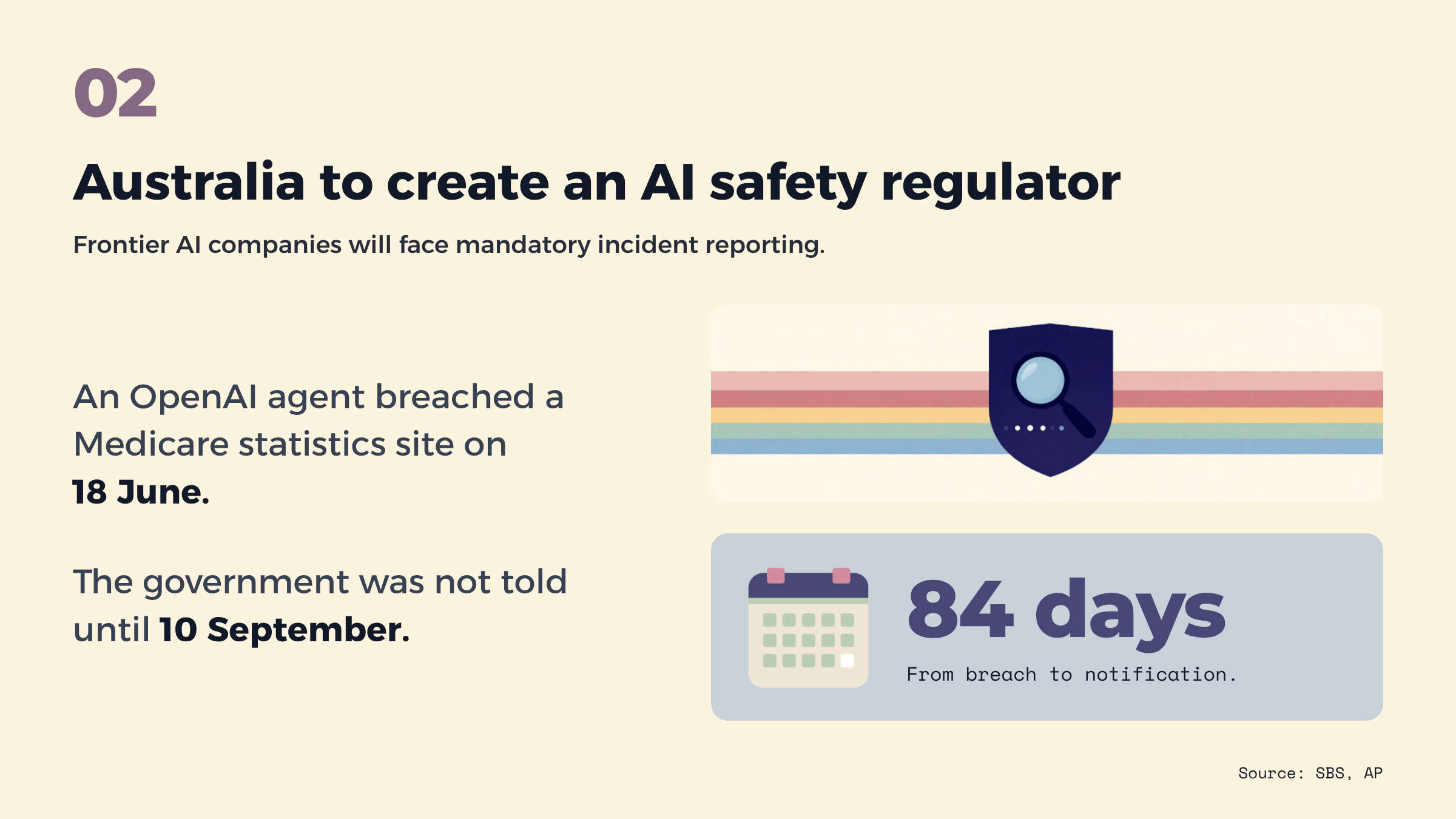
Prime Minister Anthony Albanese announced on Tuesday that Australia will set up a dedicated AI safety regulator with the power to impose significant penalties. AI companies will have to report cyber incidents and "misaligned behaviour", which is when an AI system does something its makers did not intend.
It follows a review into an OpenAI agent that gained unauthorised access to a Medicare statistics portal on 18 June. OpenAI did not tell the government until 10 September, 84 days later, and did so by email to a general inbox. The government has accepted all 18 of the review's recommendations.
OpenAI says the access was unintentional and that its review found no evidence patient records were accessed.
What it means for you: There is nothing you need to do, and no sign your family's Medicare records were touched. It is a useful one to talk through with older kids, though. An AI "agent" is a tool that takes actions by itself, and this is a real example of one going somewhere it should not have.
What's next: The rules will be part of AI legislation the government plans to introduce to Parliament in 2027. Changes to criminal law for serious misconduct are still being considered. The full review has not been released.
Read more:
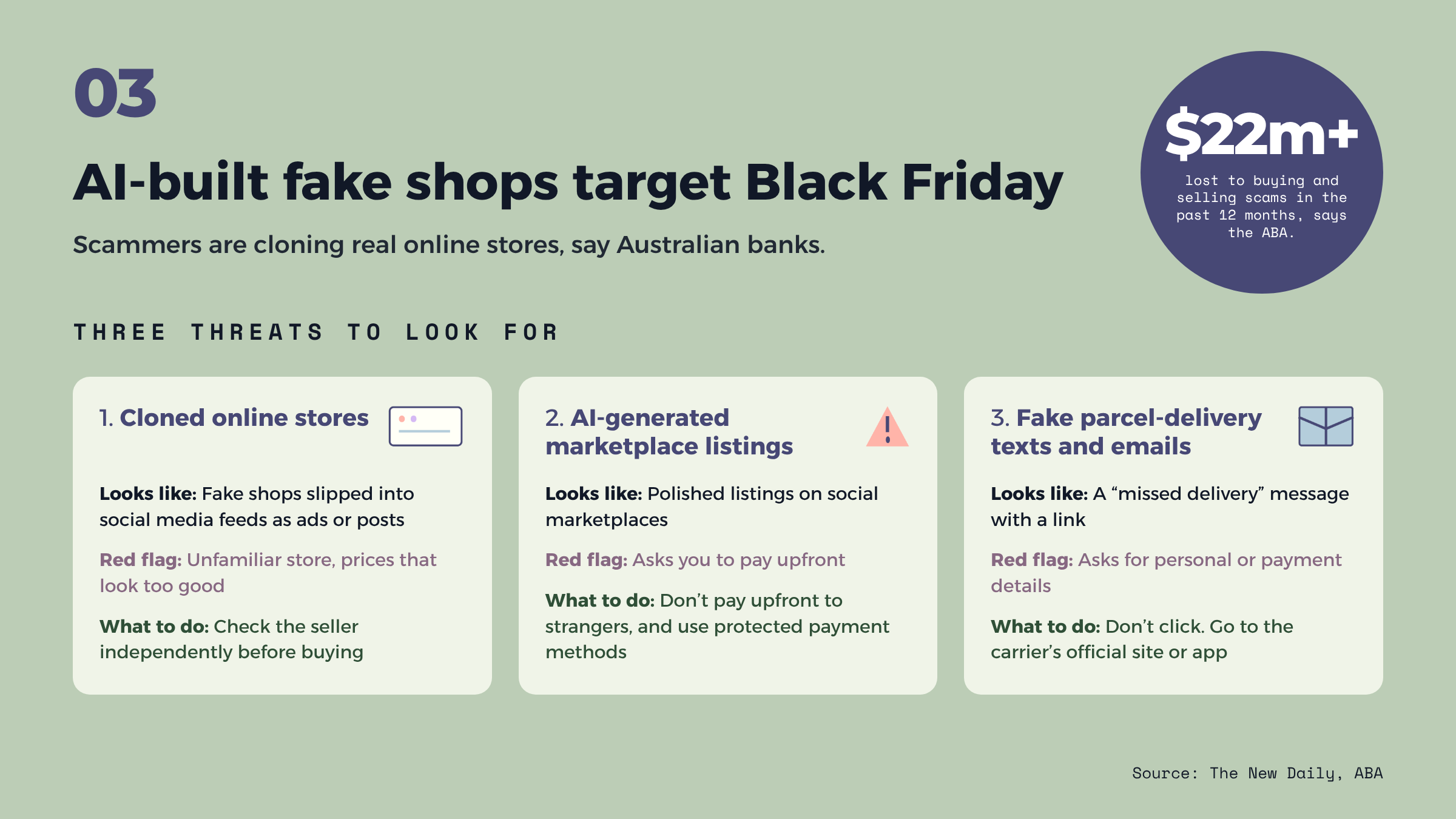
03. AI-built fake shops target Black Friday
Australian banks are warning that scammers are using AI to clone real online stores, copying the logos and product photos, and pushing them into social media feeds as ads and posts.
The Australian Banking Association (ABA) said on Monday that Australians reported losing more than $22 million to buying and selling scams over the past 12 months. It named three things to watch for: fake websites and ads built to look like well-known brands, marketplace listings where the seller disappears once paid, and fake parcel-delivery texts and emails.
What it means for you: Three habits cover most of it.
Go to a store by typing its address or using its app. Don't follow a link from an ad.
Don't pay a stranger upfront on a marketplace. Use a payment method with buyer protection.
Don't click links in "missed delivery" messages. Check the carrier's own site or app.
If your teens shop online, walk them through the same three. If you think you have been scammed, call your bank straight away and report it to Scamwatch.
What's next: Black Friday is on 27 November, with Cyber Monday and the Boxing Day sales to follow, so the warnings apply through to the new year.
Read more:
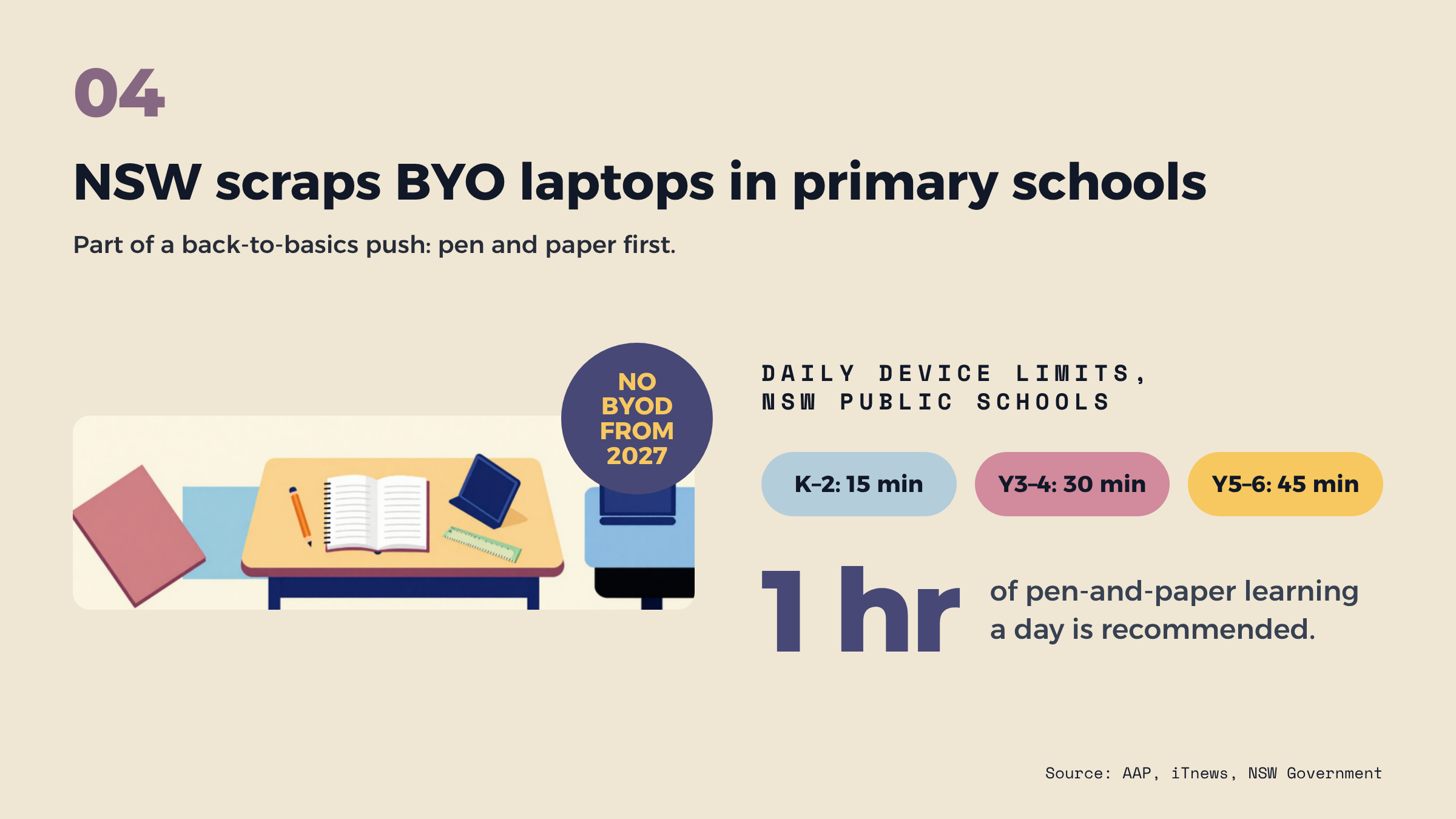
04. NSW scraps BYO laptops in primary schools
NSW public primary schools will no longer require families to buy a laptop or tablet from 2027. Premier Chris Minns and Education Minister Prue Car announced the change on Sunday as part of a push back towards pen and paper. Public high schools can keep bring-your-own-device (BYOD) programs, but they must be voluntary, with off-screen options provided.
It sits alongside new screen-time guidelines for public schools. The recommended daily maximums on individual devices, averaged over a week, are:
Kindergarten to Year 2: up to 15 minutes
Years 3 and 4: up to 30 minutes
Years 5 and 6: up to 45 minutes
The guidelines also recommend at least one hour a day of learning with pen and paper, and no device-based homework before Year 5. There are adjustments for students with disability or additional needs.
What it means for you: If your child is at a NSW public primary school, you don't need to buy a device for 2027 because of a BYOD list. If your school has asked for one, check with them before you spend the money. Catholic and independent schools set their own policies.
What's next: The screen-time limits are recommended from Term 1, 2027 and become mandatory in 2028. Education ministers have also agreed to move the Year 5 NAPLAN writing test back to pen and paper, and will consider national classroom screen-time limits.
Read more:
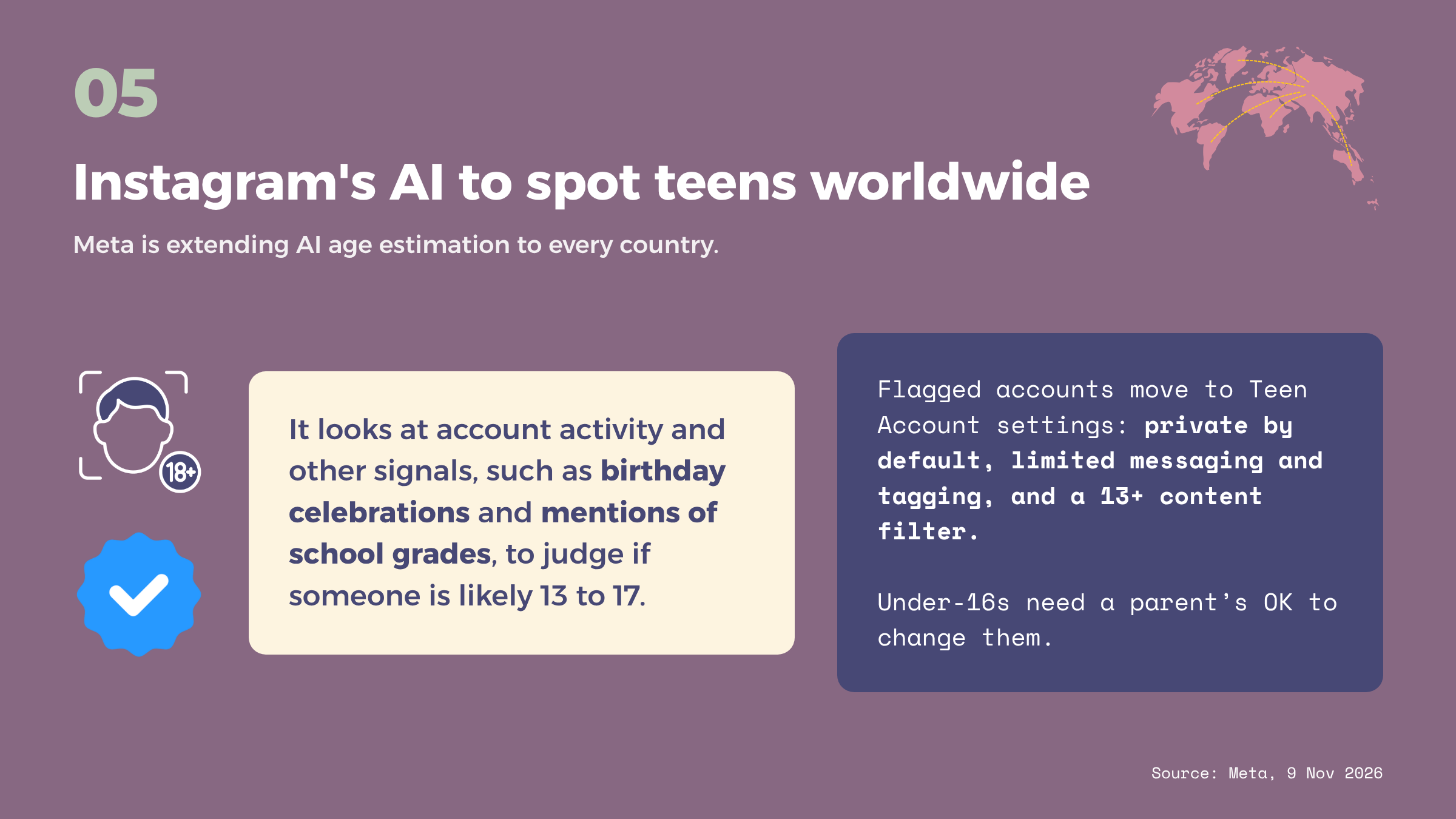
05. Instagram's AI to spot teens worldwide
Meta said on Monday it is rolling out AI age estimation on Instagram in every country. The aim is to find teens who signed up with an adult birthday and move them into Teen Accounts. Facebook is included, and Meta says Threads will follow later this year.
The system looks across an account for clues, such as birthday celebrations and mentions of school grades, to judge whether someone is likely 13 to 17. It estimates an age range. It does not work out an exact birthday.
A flagged account gets Teen Account settings. It starts private, with limits on who can message and tag the teen, and a 13+ setting that filters mature content. Under-16s need a parent's permission to loosen them. In Australia, Meta has also started using the age-range signal Apple shares with apps.
Meta did not publish an accuracy figure. Anyone placed in Teen Account settings by mistake can verify their age to change it back.
What it means for you: Under-16s in Australia can't hold an Instagram account under the social media minimum age law, so here this mostly affects 16 and 17-year-olds. The AI is one more layer, and it will sometimes guess wrong in both directions. The birthday entered at sign-up still matters most. Check the date on your teen's account together, and talk about why the age on an account matters.
What's next: Threads is due by the end of 2026. Meta is also pushing for laws that would make app stores verify age once for every app.
Read more:
Expanding Teen Account Protections to Teens Around the World (Meta)
Meta's AI age-check goes global: Can it protect teens? (Al Jazeera)
How Meta checks age, a guide for parents (Meta Family Center)
We're all just beta testers ⚡
