

Five stories on AI, tech and online safety from the stock market to your child’s classroom.
This week the AI story stopped being about what the technology can do and started being about what it costs - in money, in rules, in classrooms and in scams.
01. The AI market just blinked
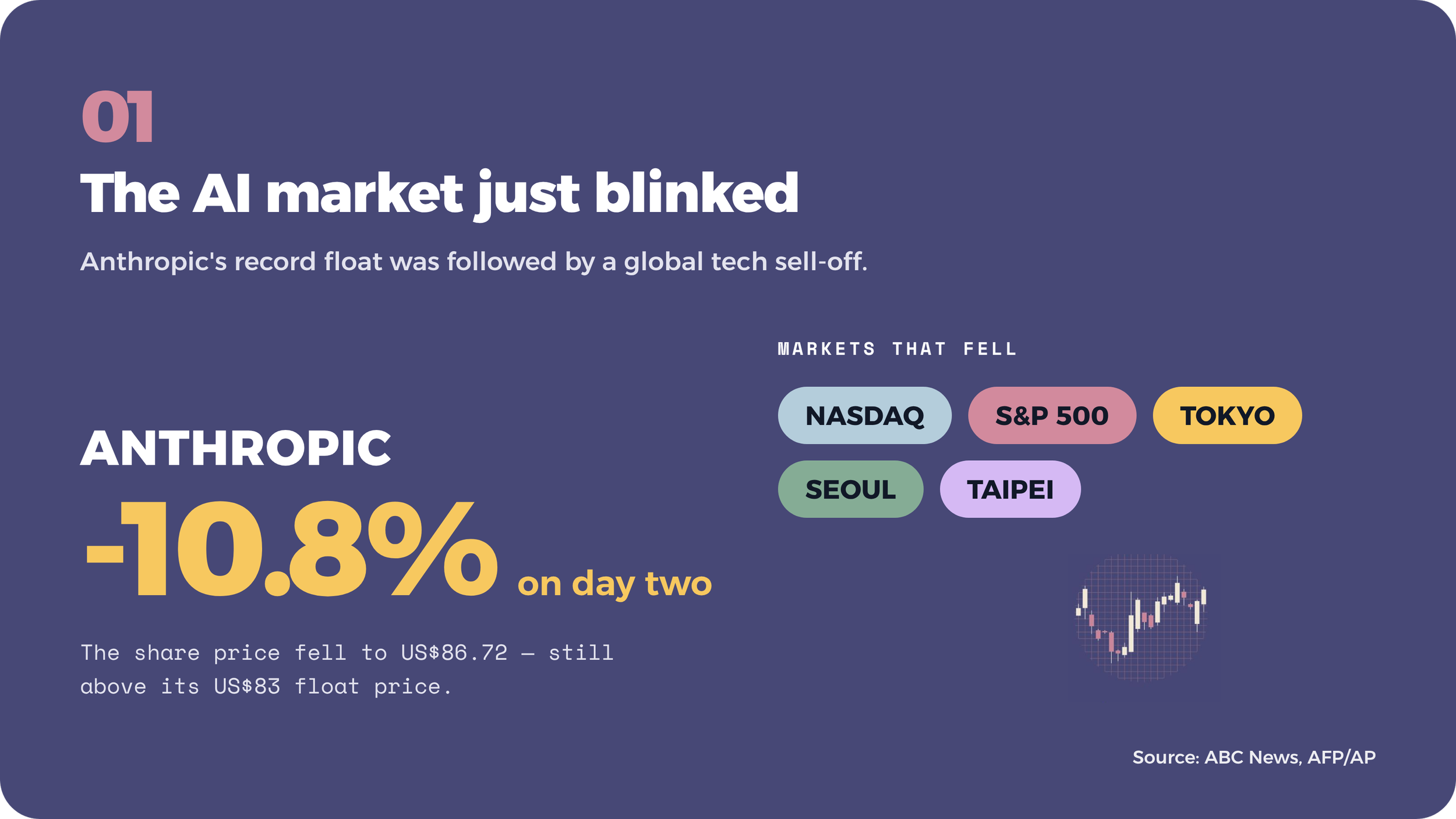
Anthropic listed on the Nasdaq at US$83. The shares rose above US$110, then fell 10.8% on their second day to US$86.72 - still above the float price, but not the debut the market expected.
The wider sell-off was the real story. The Nasdaq fell 3.2%, Nvidia 6.9%, and Tokyo, Seoul and Taipei dropped between 5 and 6.2%. AI stocks drove this year's gains, and they are now driving the slide.
Underneath it is one question: can AI revenue ever justify AI spending? Capital Economics now has an "AI bust in 2027" as its base case, while being careful to say the technology is not "a dud" and demand won't collapse. Its point is more specific - the revenue needed to justify the scale of investment "looks very demanding".
What it means for you: consumer AI is cheap because investors are funding growth, not because it's cheap to run. If that money gets nervous, free tiers and subscription prices are where households feel it first. Worth knowing before you build a family routine around a free tool.
What's next: watch whether the big AI companies keep spending at this rate. That, not the share price on any given day, is the signal.
Read more
02. AI makes Black Friday scams more convincing
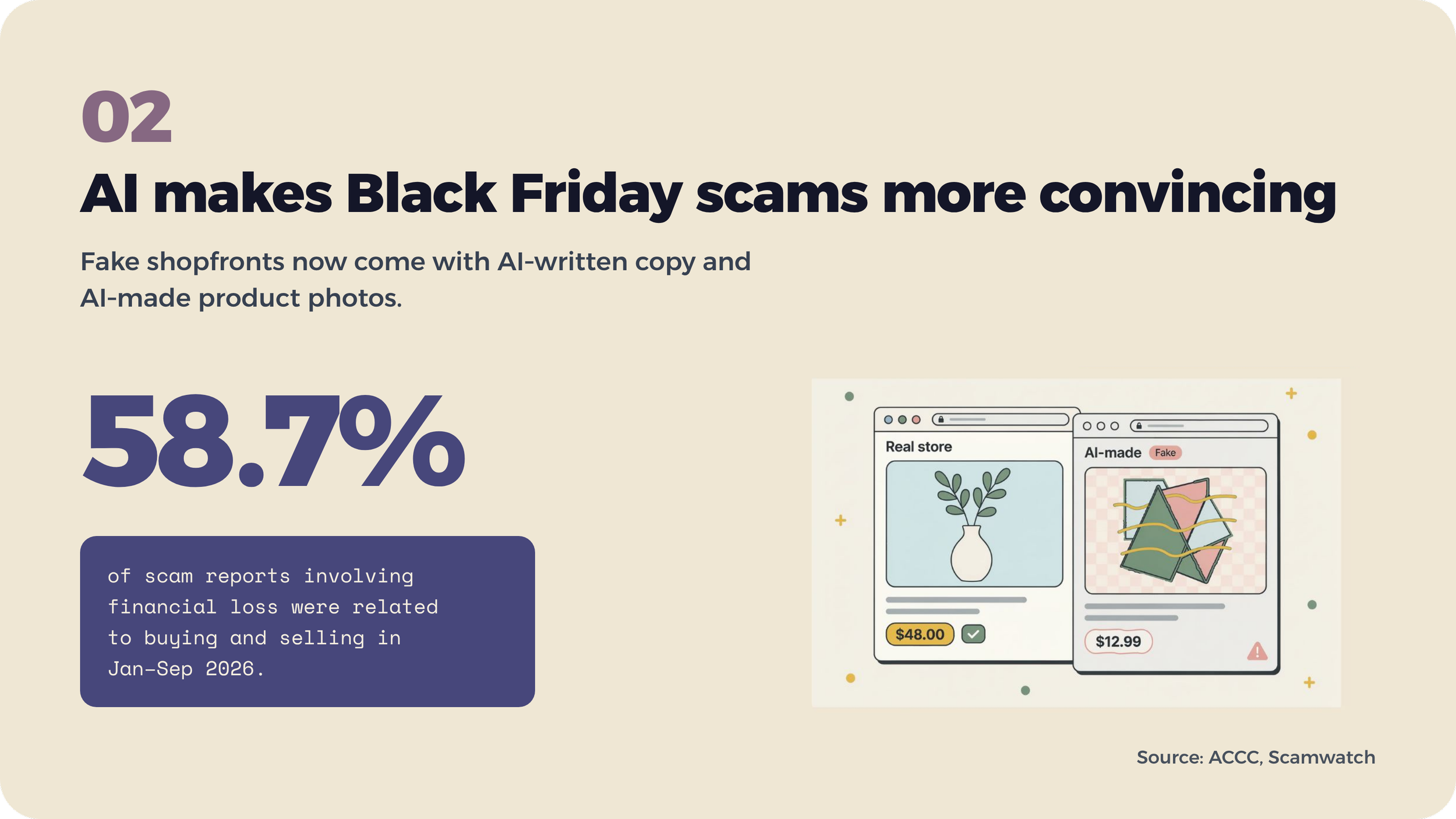
Scamwatch says artificial intelligence is making shopping scams "cheaper, faster and more convincing". Scammers are using it to generate product images, build entire websites and write the copy that makes a fake storefront read like a real business.
The scale is already significant. In the first nine months of 2026, 58.7% of scam reports involving financial loss were buying and selling scams. Reported losses across all scam types actually fell 3%, to just over $250 million, and the National Anti-Scam Centre has taken down more than 20,000 scam websites this year.
Separately, the ACCC has launched its third sweep of sale-period advertising, looking at "sitewide" discount claims that quietly exclude products, inaccurate countdown timers and misleading reference prices. Deputy chair Catriona Lowe said consumers "should be able to trust that the advertised savings and discount prices are genuine".
What it means for you: AI now writes the copy, builds the site and makes the product photos, so "it looks professional" has stopped being evidence of anything. Before buying from an unfamiliar store this weekend, search the business name plus "reviews", and check the store existed more than a month ago.
What's next: the sales land on 27 and 30 November. The ACCC says it will track whether retailers' practices improve over the next three years.
Read more
03. A law aimed at chatbots that make kids need them
A Senate committee reported on Friday and recommended Australia's Online Safety Amendment (Digital Duty of Care) Bill be passed, subject to its recommendations. The bill cleared the House on 28 October.
At its centre is a positive obligation: online services must take appropriate action to ensure a safe online environment, backed by written risk assessments at least annually. Notably, the cost of compliance is expressly excluded as a consideration - a platform can't argue that safety is too expensive.
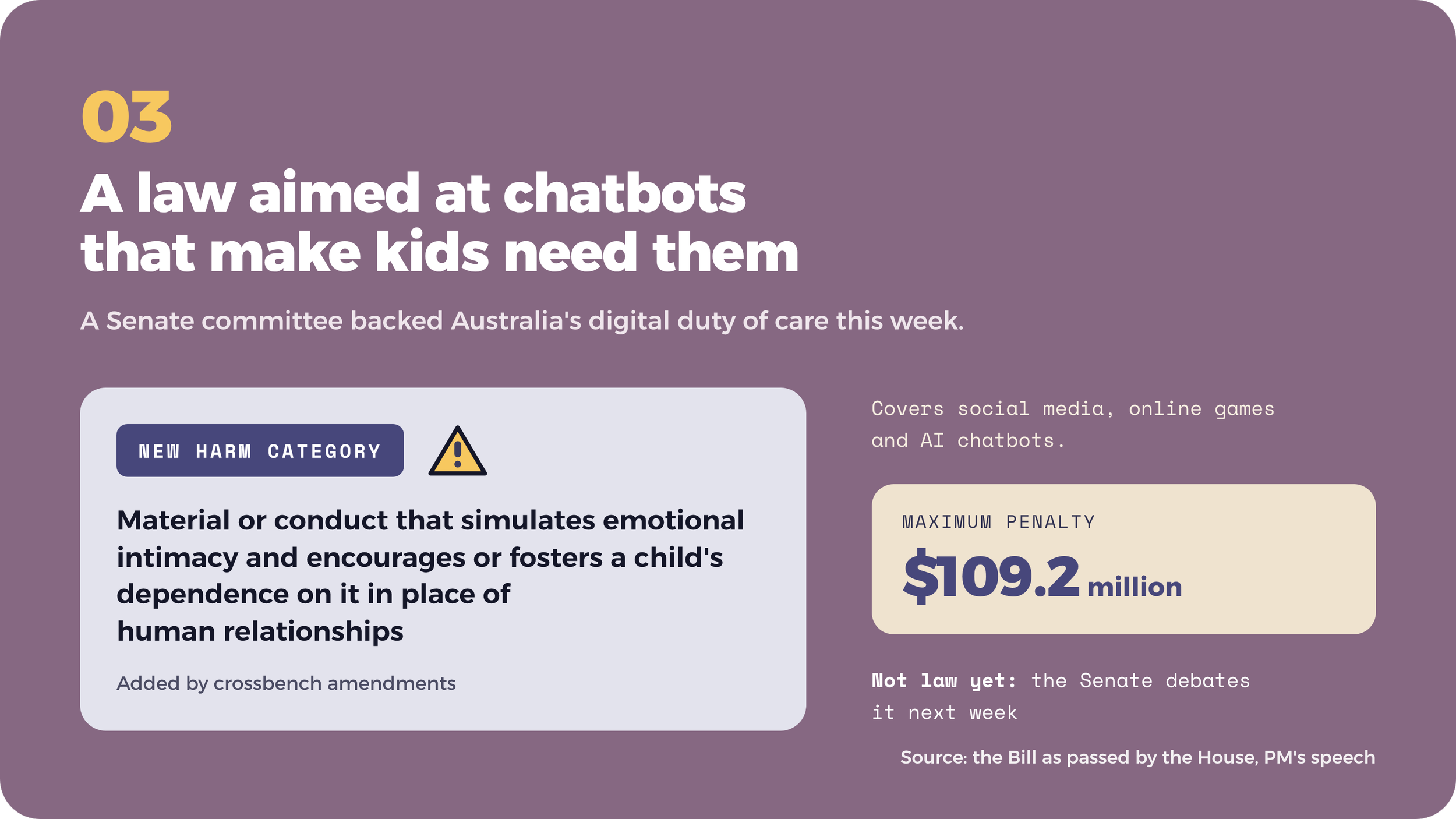
The part worth paying attention to came from crossbench amendments. A new harm category covers material or conduct that simulates emotional intimacy and encourages or fosters a child's dependence on it in place of human relationships. In plain terms, an AI companion designed to make a child need it becomes a regulated harm. It targets how the product is built, not only what it says - which is new.
The bill covers social media, online games and AI chatbots. The maximum penalty is $109.2 million. It also halves the time platforms have to respond to cyberbullying complaints, from 48 hours to 24, and folds 17 existing industry codes into a single framework.
What it means for you: nothing changes yet. The committee wants a civil right of action added, the Coalition dissented in strong terms, and the Greens say they'll only back it with bigger penalties. If it passes, the duty commences 12 months after Royal Assent.
What's next: the Senate debates it this coming week.
Read more
Senate committee backs the Digital Duty of Care Bill — news.com.au, 20 November 2026 · Prime Minister's second reading speech, 27 October 2026 · Bill record, Parliament of Australia
04. England wants AI school tools certified safe
The UK Department for Education has opened a consultation on certifying the safety of EdTech and AI products used in schools. It applies to England only - education is devolved, so Scotland, Wales and Northern Ireland set their own rules.
Four product categories are in scope: filtering products, edtech carrying out high-risk processing of children's data, student-facing generative AI tools, and student-facing personalised learning tools.
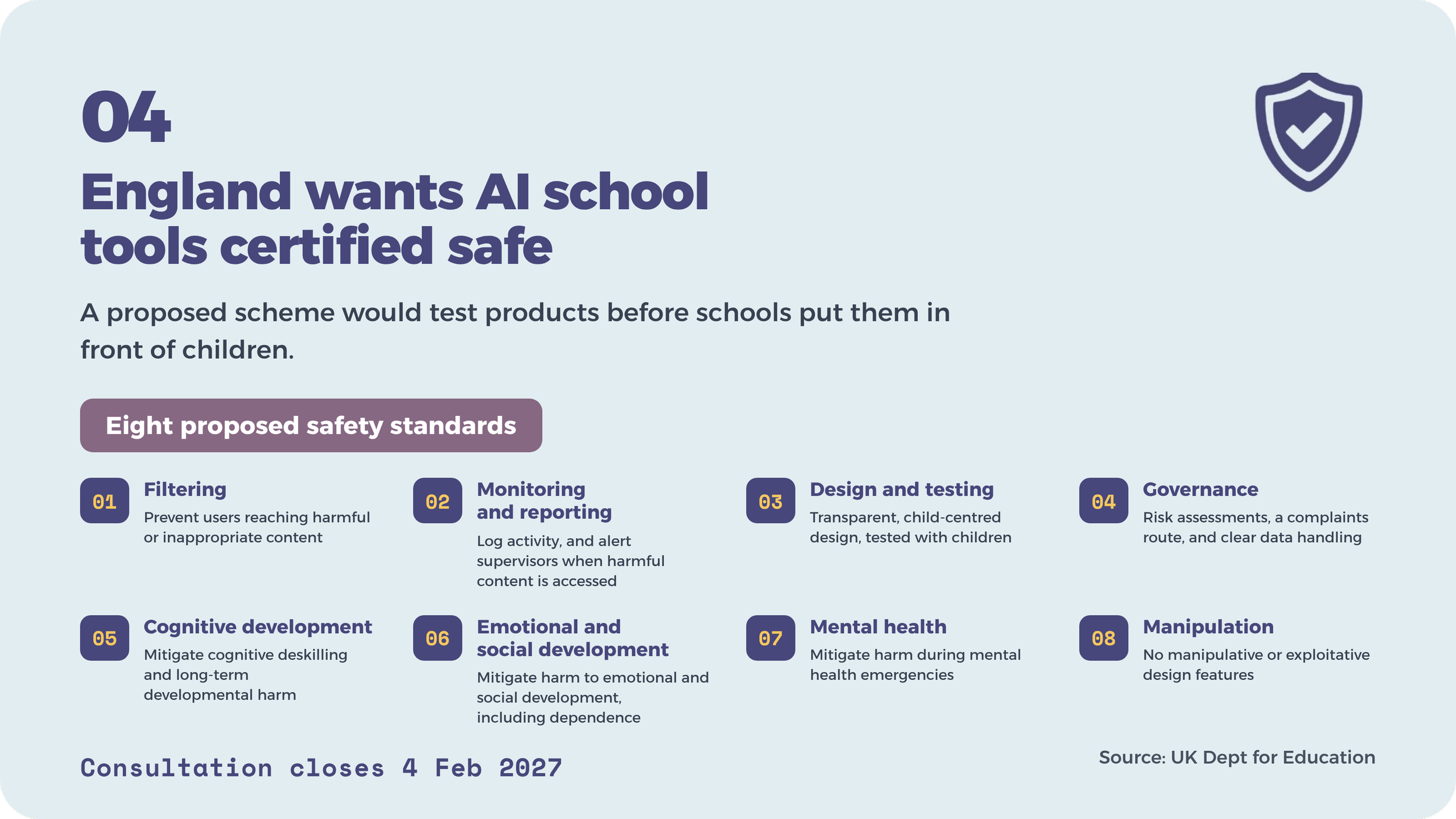
For student-facing generative AI, eight safety standards would apply:
Filtering - reliably prevent users reaching harmful or inappropriate content
Monitoring and reporting - log activity and alert supervisors when harmful content is accessed or attempts are made
Design and testing - transparent, child-centred design, with testing that includes children
Governance - risk assessments, a formal complaints route, and clear data handling and operations
Cognitive development - mitigate cognitive deskilling and long-term developmental harm
Emotional and social development - mitigate harm to emotional or social development, including emotional dependence
Mental health - mitigate harm during mental health emergencies caused or worsened by the tool
Manipulation - no manipulative or exploitative design features
The last four are the interesting half. The first four are standard procurement language. Cognitive deskilling, emotional dependence, mental health and manipulation are a regulator saying a product can be unsafe because of what it does to a child's development, not just because of what it shows them.
What it means for you: this is the first serious attempt anywhere to make "safe for a developing brain" something a supplier has to prove rather than assert. Australia has a national framework for generative AI in schools, but no equivalent product test behind it.
What's next: the consultation closes 4 February 2027, with a government response expected in spring 2027. The scheme would take at least 18 months to establish, and would be non-mandatory at launch.
Read more
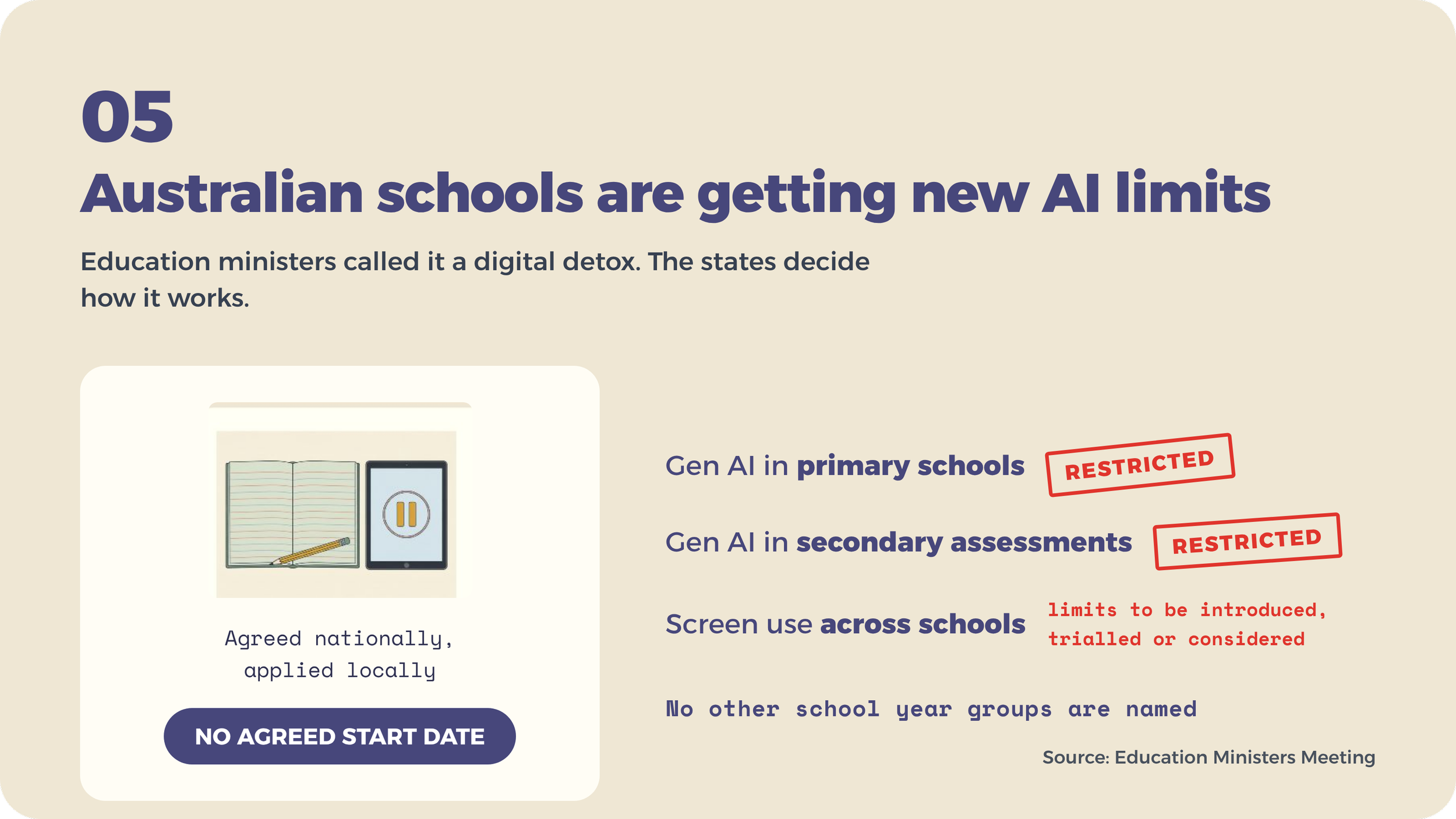
05. Australian schools are getting new AI limits
Education ministers met on 2 November and agreed to "introduce, trial or consider limits on screen use in schools and restrict the student use of Generative AI in primary schools and secondary student assessments". They called it a digital detox, and declared it a national priority.
What's actually covered: generative AI in primary schools, generative AI in secondary assessments, and screen use more broadly. No other year levels are named.
What isn't covered is just as important. There are no start dates. There is no national rule - states, territories and school sectors "determine implementation". And the screen-use wording is permissive: introduce, trial or consider.
A new Australian Schools Digital Detox Taskforce, led by an independent expert, will advise ministers on what comes next. Digital devices and AI will stay on the agenda until at least the end of 2027.
There's a tension worth naming. Ministers want this to be "evidence-based" - in the same month a University of Sydney-led review of 271 studies across more than 45 countries found only four of them were Australian. The local evidence base for restricting or adopting is thin either way. And the states were already moving: NSW capped take-home HSC assessment in September for the same reason.
What it means for you: the only way to know what changes for your child is to ask their school, because that's genuinely where the decision now sits. A fair question at the next parent-teacher night: what is this school changing, and when?
What's next: the taskforce reports to ministers, with digital devices and AI a standing agenda item until at least the end of 2027.
Read more: 05. Education Ministers Meeting communiqué, 5 November 2026 · Australia lacks evidence on GenAI in schools — University of Sydney, 3 November 2026
Coming next
The Senate debates the Digital Duty of Care Bill this week. The Joint Select Committee on Artificial Intelligence delivers its final report on 30 November. And Australia's Children's Online Privacy Code must be registered by 10 December.
Sources
02. ACCC Black Friday warning — SBS News, 11 November 2026
03. Senate committee backs the Digital Duty of Care Bill — news.com.au, 20 November 2026 · Prime Minister's second reading speech, 27 October 2026 · Bill record, Parliament of Australia
05. Education Ministers Meeting communiqué, 5 November 2026 · Australia lacks evidence on GenAI in schools — University of Sydney, 3 November 2026
